
Calculate shift hours by subtracting the start time from the end time, accounting for overnight shifts, and deducting unpaid breaks. Then convert your final working time into decimal hours if your timesheet requires it.
Calculate Shift Hours Quickly
To calculate work hours using military-time, find the elapsed time between your start and end times, account for any shift that crosses midnight, and subtract unpaid breaks.
For example, a shift from 0730 to 1600 lasts 8 hours 30 minutes. If you take a 30-minute unpaid break, your net working time is 8 hours, or 8.00 decimal hours.
Start by checking that your clock-in and clock-out times are in the correct 24-hour format. This makes the duration easier to calculate, especially when your shift ends on the following day.
Convert your clock times before calculating shift hours.
Use the Military-Time Converter to check standard AM/PM times and convert them to 24-hour format.
Need more help with timekeeping for different work schedules?
Military-Time Shift Calculator – Calculate Work Hours Step by Step
Follow these steps to calculate the hours worked between two military-times without confusing hours, minutes, or AM/PM.
1. Record Your Start Time and End Time
Write both times in four-digit military format. For example, 8:00 AM becomes 0800, while 5:00 PM becomes 1700.
End: 1700
Keep the minutes in their correct positions and make sure both times belong to the intended shift.
2. Subtract the Start Time From the End Time
For a shift from 0800 to 1700, the total elapsed time is 9 hours.
This is the total shift duration before deducting any unpaid breaks.
3. Adjust for Overnight Shifts
If your shift ends the following morning, add 24 hours to the end time before subtracting the start time.
30:00 − 22:00 = 8 hours
A shift from 2200 to 0600 the next day lasts 8 hours before breaks.
4. Subtract Unpaid Breaks
Deduct your unpaid lunch or rest break where applicable. A 9-hour shift with a 30-minute unpaid break gives you 8.5 hours of paid working time.
Only deduct breaks according to your workplace’s timekeeping policy and applicable employment rules.
Military-Time Shift Duration Formula
Use this formula to calculate total working hours:
For overnight shifts, add 24 hours to the end time before subtracting the start time. This accounts for the fact that the shift continues into the next calendar day.
Calculate the difference using hours and minutes rather than treating the entire military-time number as a decimal.
Example: 0900 to 1745
The elapsed duration is 8 hours 45 minutes, not 8.45 hours.
Convert the final duration into decimal hours only after calculating the time difference.
Need help reading and writing military-time entries correctly?
Military-Time Shift Duration Examples
These examples cover common work schedules, including regular shifts, evening work, overnight shifts, and shifts with unpaid breaks.
| Start Time | End Time | Break | Total Hours Worked |
|---|---|---|---|
| 0800 | 1600 | None | 8 hours |
| 0730 | 1600 | 30 min | 8 hours |
| 0900 | 1730 | 30 min | 8 hours |
| 0600 | 1430 | 30 min | 8 hours |
| 1400 | 2200 | None | 8 hours |
| 2200 | 0600 next day | None | 8 hours |
| 1900 | 0700 next day | 60 min | 11 hours |
| 2300 | 0730 next day | 30 min | 8 hours |
These totals assume the listed break is unpaid and the shift follows the stated start and end times. For shifts crossing midnight, the end time belongs to the next calendar day.
Need to check the final minute of a day or understand a late-night time entry?
How to Calculate Overnight Shift Hours in Military-Time
An overnight shift can be confusing because the ending time is numerically smaller than the starting time. The key is to recognize that the shift continues into the next calendar day.
Suppose you start work at 10:00 PM and finish at 6:30 AM.
= 8 hours net working time
Your total shift duration is 8 hours 30 minutes before breaks. If you take a 30-minute unpaid break, your net working time is 8 hours.
Other common overnight shift calculations include:
If you regularly work night shifts, verify your start and end times before recording the total on your timesheet.
Learn a dedicated method for shifts that run across midnight.
How to Subtract Breaks From Military-Time Shift Hours
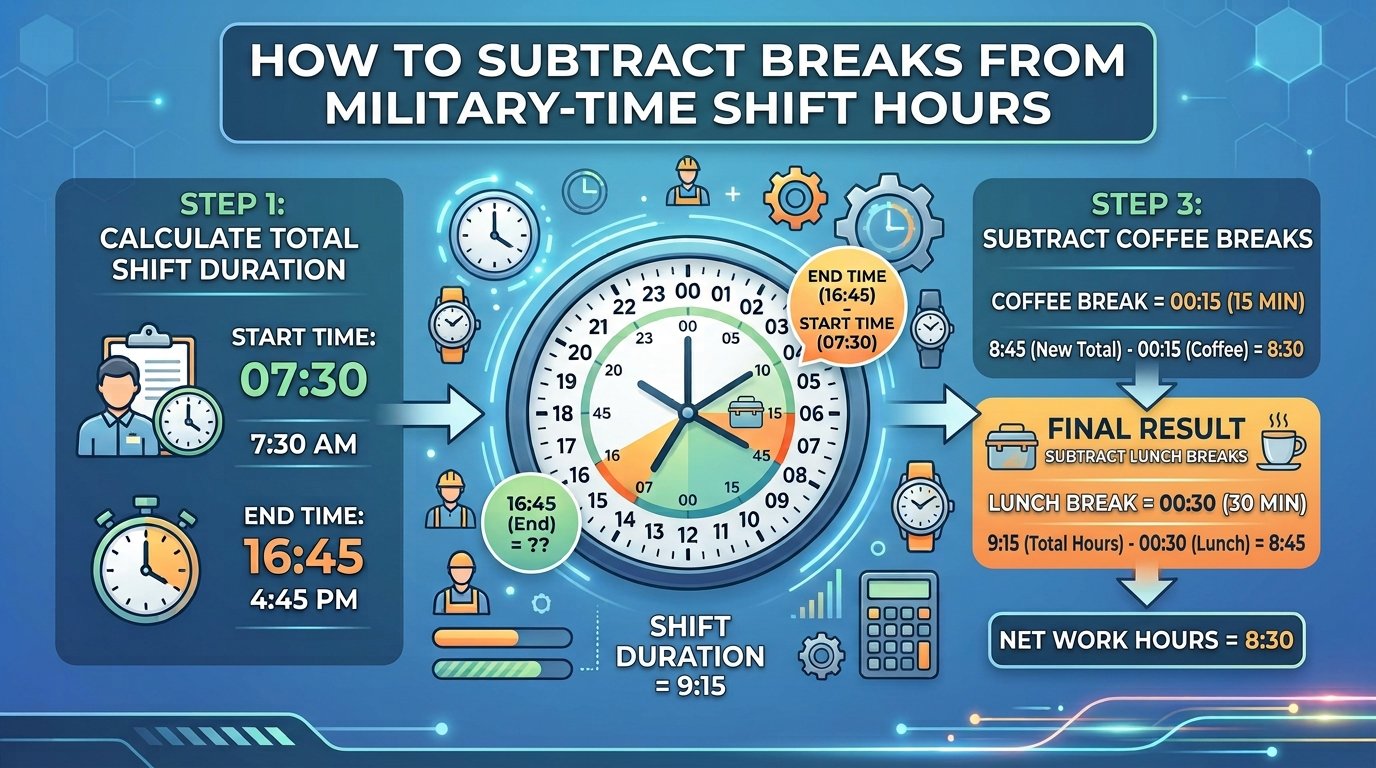
Your shift length and your actual working time may be different. The difference depends on whether your breaks are paid or unpaid and on the rules that apply to your workplace.
Use this calculation:
Example: 0830 to 1730 With a 45-Minute Break
A shift starts at 0830 and ends at 1730, with a 45-minute unpaid lunch break.
8 hours 15 minutes = 8.25 hours
The final timesheet entry is 8.25 hours, assuming the entire 45-minute break is unpaid.
Do not automatically subtract every break. Follow your employer’s timekeeping policy and the applicable employment rules.
Use these related guides to improve your military-time calculations and timesheet accuracy.
How to Convert Military-Time Shift Hours to Decimal Hours
Many timesheets and payroll systems require decimal hours instead of a format such as 8 hours 30 minutes. To convert your calculated shift duration, divide the remaining minutes by 60 and add the result to the whole hours.
Use this formula:
Use this quick reference when entering shift durations into a timesheet.
| Hours and Minutes | Decimal Hours |
|---|---|
| 4 hours 15 minutes | 4.25 |
| 6 hours 30 minutes | 6.50 |
| 7 hours 15 minutes | 7.25 |
| 7 hours 30 minutes | 7.50 |
| 7 hours 45 minutes | 7.75 |
| 8 hours 15 minutes | 8.25 |
| 8 hours 30 minutes | 8.50 |
| 8 hours 45 minutes | 8.75 |
| 10 hours 30 minutes | 10.50 |
Why 7 Hours 30 Minutes Equals 7.50
Divide 30 minutes by 60 to get 0.5, then add 7 hours.
Do not enter 7 hours 30 minutes as 7.30 decimal hours. Minutes are based on 60 minutes per hour, while decimal hours represent a fraction of an hour.
If you need to convert AM/PM entries before recording a shift, check the time format first and then calculate the duration.
Explore Military Time Examples From 0000 to 2359
Use the complete military time conversion chart to check hours, minutes, and AM/PM equivalents.
How to Calculate Total Hours Worked for a Timesheet
If you work different shifts throughout the week, calculate the net hours for each shift first, then add the results together. Keep the daily totals in hours and minutes until you are ready to convert them to decimal hours.
For example, consider this three-day schedule:
| Day | Shift | Unpaid Break | Net Time |
|---|---|---|---|
| Monday | 0800–1630 | 30 min | 8 hours |
| Tuesday | 0900–1730 | 30 min | 8 hours |
| Wednesday | 2200–0600 | None | 8 hours |
| Total | Three shifts | 24 hours | |
Your total for these three shifts is 24 working hours.
For a full weekly timesheet, use the same method for each day, making sure you record overnight shifts against the correct work dates. If your payroll system tracks overtime, apply the relevant overtime rules separately rather than assuming every hour beyond a daily shift is automatically overtime.
Working with multiple clock-in and clock-out entries?
Common Mistakes When Calculating Shift Duration Using Military-Time
Small timekeeping errors can create incorrect timesheet totals. Check these points before submitting your work hours.
1. Forgetting Midnight
A shift from 2200 to 0600 lasts 8 hours, not a negative duration.
2. Confusing Military-Time With Decimal Time
1530 means 3:30 PM, not 15.30 decimal hours.
3. Subtracting Minutes Incorrectly
When the end minutes are smaller than the start minutes, borrow 60 minutes from the hour column.
= 8 hours 15 minutes
4. Deducting Paid Breaks Automatically
Only subtract breaks according to the relevant pay and workplace rules.
5. Entering Minutes as Decimal Digits
Eight hours and 45 minutes is 8.75 hours, not 8.45.
6. Ignoring the Next Workday
Record shifts crossing midnight with the appropriate dates, especially when reviewing payroll records.
For an easier conversion process, verify your clock times before working out the shift duration.
Need to understand how military-times are spoken when communicating a shift schedule?
Frequently Asked Questions
How do you calculate hours between two military-times?
Subtract the start time from the end time. If the shift crosses midnight, add 24 hours to the end time first. Then deduct any unpaid breaks. For example, 0800 to 1630 is 8 hours 30 minutes, or 8 hours after a 30-minute unpaid break.
How do you calculate an 8-hour shift in military-time?
Add 8 hours to your starting time. A shift beginning at 0700 ends at 1500, while a shift beginning at 1400 ends at 2200, assuming no unpaid break needs to be added to the scheduled duration.
How do you calculate a 12-hour shift using military-time?
Add 12 hours to the starting time, accounting for midnight if necessary. For example, a shift starting at 1800 ends at 0600 the next day. If you have a 30-minute unpaid break, the net working time is 11 hours 30 minutes.
How do you calculate hours worked from 0700 to 1530?
The duration from 0700 to 1530 is 8 hours 30 minutes. With a 30-minute unpaid break, the net working time is 8 hours, equivalent to 8.00 decimal hours.
How do you calculate work hours from 2300 to 0700?
The shift runs from 11:00 PM to 7:00 AM the following day. It lasts 8 hours before any unpaid breaks are deducted.
What is 7 hours and 45 minutes in decimal time?
Seven hours and 45 minutes equals 7.75 decimal hours. Divide 45 by 60 to get 0.75, then add 7.
Can military-time be used for employee timesheets?
Yes. Military-time can help keep clock-in and clock-out records consistent, particularly for night shifts, hospitals, security teams, transport services, and other workplaces operating around the clock. Follow your organization’s required time-entry format.
What is the easiest way to calculate shift hours without making mistakes?
Record the start and end times in 24-hour format, calculate the elapsed duration, account for overnight shifts, and subtract applicable unpaid breaks. Then convert the result to decimal hours if your timesheet requires it. The Military-Time Converter can help you verify the time format before calculating.
Calculate Military-Time Accurately With Calculator Online Pro
Accurate shift calculations help employees, managers, and payroll teams maintain consistent work-hour records. Whether you are checking a standard daytime shift, calculating overnight hours, or preparing a weekly timesheet, the process becomes easier when you use the correct time format and handle breaks consistently.
Before calculating your total hours, make sure your start and end times are correct. Work out the elapsed time, adjust for shifts that cross midnight, and subtract unpaid breaks where applicable.
Military-Time Converter
Convert AM/PM time to 24-hour time and verify your shift entries before calculating work hours.