
Calculate your present or future value to see how the timing of money affects your financial calculations.
Want to know what your money could be worth in the future, or how much a future payment is worth today? Use our present and future value calculator to work out present value and future value using an amount, an interest or discount rate, and a selected time period.
Whether you are estimating investment growth, comparing payment options, planning savings or working through a finance assignment, these calculations help you compare money received at different points in time.
Enter your figures, select the calculation you need and review the result. For a more meaningful estimate, use a rate and compounding frequency that match your financial situation.
How to Use the Present and Future Value Calculator
Start by deciding which amount you want to calculate. If you know how much money you have today and want to estimate its value later, calculate future value. If you know a future payment and want to estimate what it is worth today, calculate present value.
Follow these steps:
Make sure the interest rate and time period use compatible units. If your rate is annual but your calculator asks for monthly periods, confirm how it converts the rate before relying on the result.
Want a fuller walkthrough of time calculations?
Present Value vs. Future Value: Which One Do You Need?
The two calculations answer different financial questions.
| Your question | Calculation to use |
|---|---|
| How much could my savings grow to? | Future value |
| What will today’s investment be worth in five years? | Future value |
| What is a payment due in three years worth today? | Present value |
| How much should I have now to reach a future target? | Present value |
| How can I compare payments received at different times? | Present value of each payment at a common date |
For example, $1,000 invested today at a constant annual rate of 5%, compounded annually for three years, grows to approximately $1,157.63. Conversely, $1,500 received three years from now has a present value of approximately $1,295.76 at a 5% annual discount rate.
These examples assume annual compounding, no additional deposits or withdrawals, and a constant rate throughout the period.
Time Value of Money Formula
You can calculate the future value of a single amount using the following formula:
To calculate present value, rearrange the same relationship:
Where:
For annual compounding over three years, a 5% annual rate is entered as 0.05 and the number of periods is three.
When compounding occurs more than once per year, the formula must account for the rate and number of compounding periods. With a nominal annual rate compounded m times per year, the formulas become:
Future value:
Present value:
Here, m is the number of compounding periods each year and t is the number of years. These formulas assume a nominal annual rate divided evenly across the compounding periods.
How to Calculate Future Value of an Investment
Use a future value calculation when you want to estimate how much a current amount could be worth after earning interest or investment returns.
Example: $5,000 for Five Years at 6%
Suppose you invest $5,000 for five years at an assumed annual rate of 6%, compounded annually, without making additional deposits.
The difference between the final amount and the original deposit is approximately $1,691.13 in growth under these assumptions.
This is a mathematical projection, not a guarantee of investment performance. Actual investment returns may vary, and fees, taxes and withdrawals can affect the final amount.
Use the future value option to test different rates and time periods. For example, you could compare a five-year projection with a ten-year projection while keeping the starting amount and annual rate unchanged.
How to Calculate Present Value of a Future Payment
Present value is useful when you need to evaluate money that will arrive later rather than today.
Example: $10,000 in Five Years at 4%
Suppose you expect to receive $10,000 in five years and want to estimate its present value using an annual discount rate of 4%, compounded annually.
At the assumed 4% discount rate, $10,000 due in five years has a calculated present value of about $8,219.27.
This does not mean the future payment will actually be worth that amount in every financial situation. The answer depends on the discount rate chosen and the assumptions behind it.
Present value calculations are useful when comparing payment dates, evaluating projected cash flows or estimating the current equivalent of a future financial amount.
How Interest Rates Affect Present and Future Value
The rate you enter can change the result substantially, especially over longer periods.
For example, a $1,000 amount invested for five years with annual compounding would produce different results at different rates.
| Annual rate | Future value after 5 years |
|---|---|
| 2% | $1,104.08 |
| 4% | $1,216.65 |
| 6% | $1,338.23 |
| 8% | $1,469.33 |
These examples assume the rate remains constant, interest compounds annually, and there are no additional deposits or withdrawals.
Use the calculator to compare scenarios rather than assuming that the highest projected return will necessarily be available or appropriate for you.
Need a more detailed calculation of the length of a period?
Compound Interest and the Time Value of Money
Compound interest means that interest earned can become part of the amount on which future interest is calculated. Over time, this can make the balance grow faster than it would under simple interest at the same nominal annual rate.
Compound vs. Simple Interest at 5%
$1,000 earning 5% annually with annual compounding becomes $1,050 after one year. In the second year, the 5% rate applies to $1,050, producing a balance of $1,102.50.
With simple interest, by comparison, interest is calculated only on the original $1,000. At 5% per year for two years, the balance would be $1,100 before any other adjustments.
The difference becomes more noticeable over longer periods. If you are estimating investment growth, check whether the calculator uses simple interest or compound interest and select the method appropriate to your question.
How Inflation Affects the Value of Money
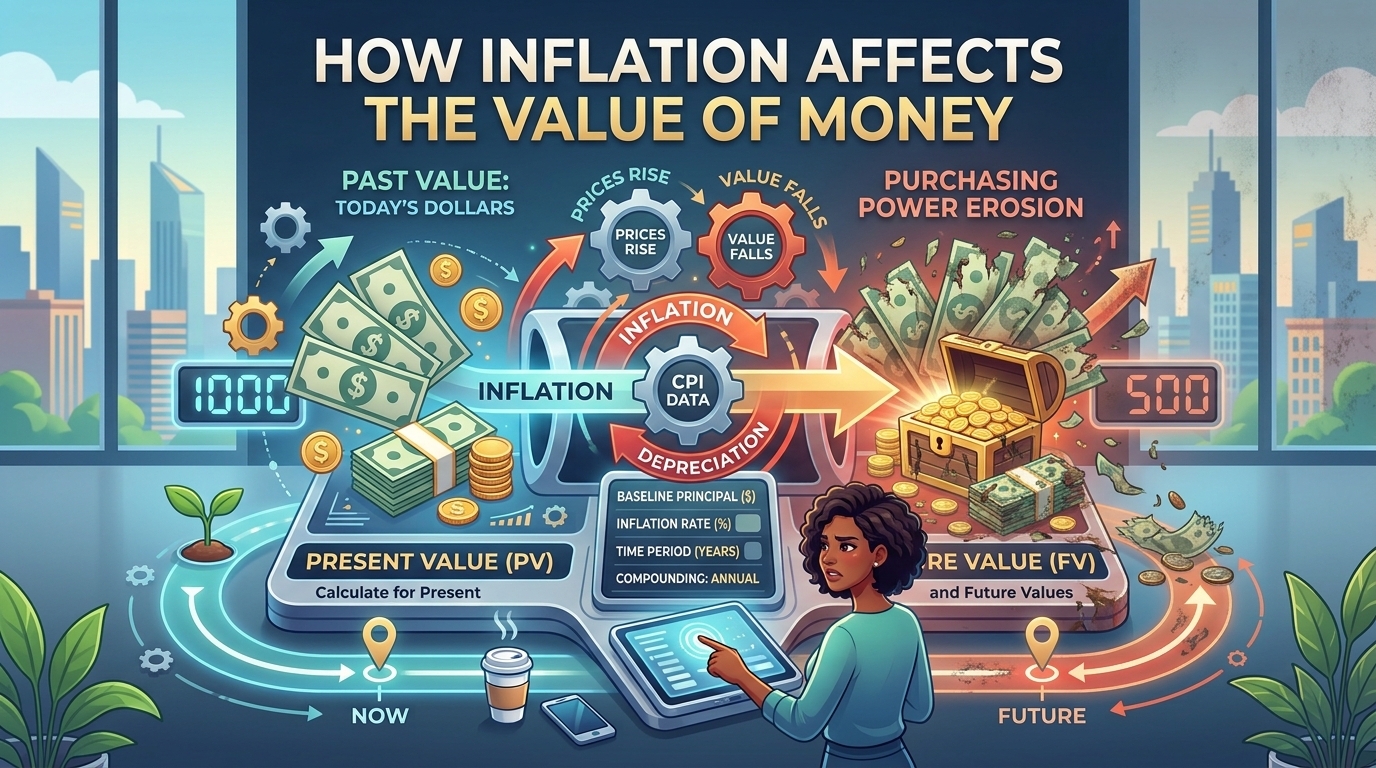
A projected future balance does not automatically tell you how much you will be able to buy with it.
Inflation can reduce purchasing power over time, meaning the same amount of money may buy fewer goods and services in the future.
For example, if prices rise by an assumed 3% per year, the purchasing power of $1,000 after ten years would be equivalent to approximately $744.09 in today’s money, assuming that inflation rate remains constant.
The calculation is:
This is different from calculating an investment’s future account balance. Investment growth and inflation are separate factors, and the result depends on the rates used.
If you want to estimate purchasing power rather than just the account balance, use an inflation assumption appropriate to the period and location you are considering.
Tracking hours rather than money?
Time Value of Money with Regular Deposits or Payments
Some financial questions involve a series of cash flows rather than one starting amount or one future payment.
Examples include:
For a series of equal payments, the calculation depends on the payment amount, interest rate, number of payments and when each payment occurs.
For example, payments made at the beginning of each month have a different accumulated value from payments made at the end of each month. The timing of the cash flows must be included in the calculation.
If you need to include recurring contributions, check whether your calculator supports periodic payments. A single-amount present value or future value calculation does not automatically include deposits or withdrawals.
Time Duration Calculator
Work out the elapsed time between a start time and an end time.
Common Time Value of Money Calculation Mistakes
Check these details before using your result in a financial decision or assignment.
1. Mixing Up Present Value and Future Value
Present value works backward from a future amount. Future value projects a current amount forward. Choosing the wrong calculation can answer a different question from the one you intended.
2. Entering the Interest Rate Incorrectly
A rate of 5% is entered as 0.05 in a manual formula, not 5. If the calculator accepts a percentage input, follow its specified format.
3. Using the Wrong Compounding Frequency
An annual rate with monthly compounding requires the appropriate periodic rate and number of periods. Do not apply an annual rate as though it were a monthly rate.
4. Confusing Interest Earned with the Final Balance
Future value includes the original principal and the growth under the stated assumptions. Interest or investment growth is the difference between the final amount and the original amount when there are no other cash flows.
5. Ignoring Inflation
A higher future balance does not necessarily mean a proportionately higher level of purchasing power.
6. Forgetting Fees and Taxes
A mathematical projection may not reflect the amount you ultimately keep after investment fees, taxes or other costs.
7. Comparing Payments from Different Dates Without Adjusting for Time
To compare cash flows fairly, express them at a common date using a consistent discount rate and suitable assumptions.
Want a clearer way to total hours over a period?
Who Can Use a Present & Future Value Calculator?
This calculator can help with different types of financial calculations.
The calculator provides numerical results based on your inputs. It does not determine whether an investment, loan or payment arrangement is suitable for your circumstances.
Need dedicated clock-in, clock-out, and break calculations?
Frequently Asked Questions
What does a present and future value calculator calculate?
It calculates the present value or future value of money using an amount, an interest or discount rate and a time period. Depending on the tool, it may also support different compounding frequencies or recurring payments.
How do I calculate the time value of money?
For a single amount with periodic compounding, multiply the present value by the compounding factor to calculate future value. To find present value, divide the future amount by that same factor. The rate and number of periods must use compatible units.
What is the difference between present value and future value?
Present value estimates the value of a future amount at an earlier date. Future value estimates what a current amount could become at a later date under an assumed rate of growth.
How much will $1,000 be worth in five years at 5% interest?
With annual compounding and no additional deposits or withdrawals, $1,000 would grow to approximately $1,276.28 after five years at 5% annually.
How do I calculate present value from future value?
Divide the future amount by one plus the periodic discount rate raised to the total number of periods. For example, discounting $1,000 due in three years at 5% annually gives a present value of approximately $863.84.
Does compounding frequency affect future value?
Yes. When the same positive nominal annual interest rate is compounded more frequently, future value is generally higher, assuming the same starting amount and investment period. The effect depends on the rate and compounding schedule.
Does the time value of money account for inflation?
Not automatically. A standard present value or future value calculation uses the interest or discount rate you enter. To estimate future purchasing power, use an appropriate inflation assumption or a separate inflation calculation.
Can I use a present and future value calculator for loans?
You can use present value and related cash-flow calculations to examine loan amounts and future payments. However, a full loan repayment calculation may require payment frequency, loan term, fees and repayment timing that a basic present and future value calculator may not support.
Can I calculate regular monthly investments?
Only if the calculator supports recurring payments or contributions. A calculator designed for a single lump sum will not include monthly deposits unless that feature is specifically implemented.
Is the present and future value calculator accurate?
It can calculate the mathematical result accurately for the formula and inputs it supports. Actual investment outcomes, inflation, taxes, fees and changes in interest rates may cause real-world results to differ from projections.
Calculate Present Value and Future Value
When you need to compare money today with money expected in the future, use consistent assumptions for the amount, rate, time period and compounding frequency.
Enter your figures into the calculator above to estimate present value or future value and compare different scenarios. Review the assumptions behind each result before using it to support an investment, savings or business decision.
The calculator is a practical starting point for financial calculations, helping you understand how interest, time and cash-flow timing can change the value of money.
Time Calculator
Use the Time Calculator for everyday time calculations.