
Estimate your future balance based on your starting amount, regular contributions, expected annual return and investment period.
Want to know how much your investment could be worth in 5, 10, 20 or 30 years? Use our investment calculator over time to estimate your future balance based on your starting amount, regular contributions, expected annual return and investment period.
Enter your figures to see how different investment amounts, time periods and growth rates could affect your results. Whether you are building savings, investing for retirement, planning a major purchase or comparing long-term financial goals, an investment growth calculator can help you explore different possibilities before making a decision.
Use the calculator above to:
Investment projections are estimates, not guaranteed returns. Actual results depend on investment performance, fees, taxes, inflation and other factors.
How Much Could Your Investment Be Worth Over Time?
Your future investment value depends on four main factors: how much you invest initially, how much you add, the return you earn and how long your money remains invested.
For example, a one-time deposit follows a different growth path from an investment plan that combines an initial balance with monthly contributions. When returns are reinvested, compound growth can also increase the effect of time.
Use the calculator to test your own figures rather than relying on a single assumed outcome.
What affects investment growth?
Changing even one input can produce a different projection. Try several realistic assumptions to see how sensitive your results are.
How to Use the Investment Calculator
Follow these steps to estimate your investment’s potential future value:
For a more useful comparison, keep your starting amount and time period the same while changing one variable at a time.
Want a fuller walkthrough of time calculations?
Investment Growth Example: How Your Money Could Grow
Consider a hypothetical investment plan with the following figures:
| Investment Detail | Example Amount |
|---|---|
| Initial investment | $5,000 |
| Monthly contribution | $200 |
| Assumed annual return | 7% |
| Investment period | 20 years |
| Total monthly contributions | $48,000 |
| Total money contributed, including the initial amount | $53,000 |
With monthly compounding and contributions made at the end of each month, these assumptions produce an estimated future balance of approximately $124,000 before fees, taxes and inflation adjustments.
Estimated Growth
The difference between the projected balance and the amount contributed represents estimated investment growth under this model. It is not a promise that the investment will achieve a 7% annual return.
Your actual result may be higher or lower because market returns fluctuate. Use the calculator to test different return assumptions and see how the outcome changes.
Investment Calculator With Monthly Contributions
Regular contributions can make a substantial difference to a long-term investment plan. Instead of relying only on an initial deposit, you add money throughout the investment period.
A monthly investment calculator helps you explore how those deposits could build your balance over time. Each contribution adds to the amount invested, and subsequent returns may apply to the growing balance.
This can be useful when planning to invest part of your salary, build a long-term savings portfolio or contribute regularly towards a financial goal.
What if you increase your monthly investment?
Suppose you can afford to invest more each month after a pay rise or a reduction in expenses. Increasing your contribution may raise your projected future balance, even if your assumed annual return stays unchanged.
Use the calculator to compare your current monthly contribution with a higher amount. Check whether the larger contribution is affordable within your budget, rather than choosing an amount based only on the projected result.
How Compound Growth Changes an Investment Over Time
Compounding occurs when investment gains remain invested and can generate further gains. Over a longer period, this can have a meaningful effect on the projected balance.
The result depends on the return assumption, how often returns are compounded, whether gains are reinvested and whether you continue adding money.
Investment growth formula
For a single initial investment with periodic compounding, the standard future value formula is:
Where:
This formula describes a lump-sum investment. If you also make monthly contributions, those contributions must be calculated separately and added to the future value of the initial amount.
The formula is a mathematical model. It does not capture the ups and downs of real investment markets or guarantee a particular outcome.
Want to explore how money changes in value over time?
Compare Investment Growth Over 5, 10, 20 and 30 Years
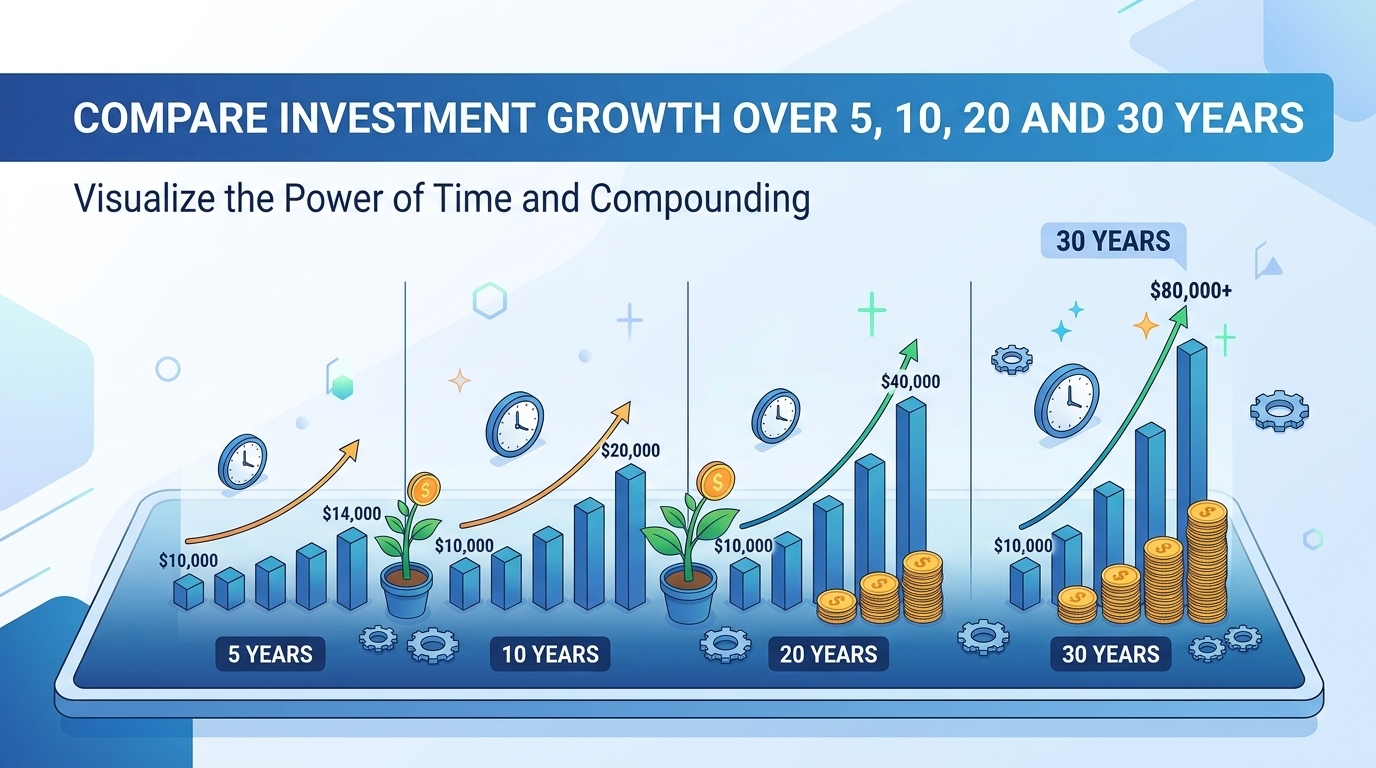
The length of time you invest can significantly affect your projection. A short-term plan may show limited compounding, while a longer period gives the assumed returns more time to build on the existing balance.
Use the calculator to compare different time horizons while keeping the other inputs unchanged.
A longer investment period does not remove investment risk. The result depends on what you invest in, the returns achieved and whether you can remain invested throughout the period.
Need to work out the length of a time period?
Calculate Investment Returns With Different Rates
Not sure what annual return to enter? Rather than relying on one figure, calculate several scenarios.
For example, compare a lower, middle and higher assumed return while keeping the investment amount, monthly contributions and time period the same. This shows how much your estimated future balance depends on the return assumption.
Remember to check whether the rate you enter is before or after investment fees, and whether it represents a nominal return or a return adjusted for inflation. Using inconsistent assumptions can make comparisons misleading.
Historical performance does not guarantee future performance, and no calculator can predict market returns with certainty.
Time Calculator
Need to add, subtract or compare time while planning your schedule?
Investment Growth Before and After Inflation
A future balance tells you how much money you might have in the future under your chosen assumptions. It does not automatically tell you how much that money will buy.
Inflation causes the prices of goods and services to change over time. As a result, a balance that looks large in future pounds or dollars may have less purchasing power than the same amount today.
If your calculator includes an inflation adjustment, enter an assumed annual inflation rate to estimate the future balance in today’s money. Treat this as an illustration because actual inflation can vary and different expenses may rise at different rates.
When planning a future goal, consider both the projected account balance and the likely cost of the goal at the time you expect to pay for it.
How Much Should You Invest Each Month to Reach a Goal?
If you have a target amount in mind, such as a house deposit, education fund or retirement pot, work backwards from the goal.
Start by identifying:
Use the investment calculator to test different contribution levels and time periods. If the projected balance falls short of your goal, you could explore contributing more, extending the time frame or reviewing the target amount.
Do not assume that a higher return will make up a shortfall. Higher potential returns usually involve different risks, and actual performance may not match your assumptions.
Planning a specific financial goal?
Calculate a few scenarios using your own figures, then compare the required contributions with your budget before deciding on your next step.
Planning around work income and hours?
Common Investment Calculator Mistakes to Avoid
1. Treating the projected return as guaranteed
An assumed annual return is an input, not a prediction. Actual returns can vary significantly from year to year, and investments can lose value.
2. Forgetting regular contributions
If you intend to invest monthly but calculate only your initial deposit, the result will not reflect your complete plan.
3. Ignoring fees and taxes
Investment charges and tax liabilities can reduce the amount you ultimately keep. Where possible, use return assumptions that account for relevant costs, and review tax treatment for your circumstances.
4. Overlooking inflation
A future balance is not the same as today’s purchasing power. Consider inflation when planning for expenses that may occur many years from now.
5. Comparing different scenarios unfairly
When comparing plans, keep the assumptions consistent except for the variable you want to test. Otherwise, it may be difficult to tell what caused the difference.
6. Relying on one optimistic scenario
Run conservative and more favourable illustrations. A range of outcomes can give you a more balanced view of uncertainty than a single projected figure.
Tracking the hours you work to fund your plan?
Who Can Benefit From an Investment Growth Calculator?
An investment calculator over time can help people explore a variety of financial goals, including:
The calculator supports planning and comparison. It does not select investments or replace advice based on your financial circumstances.
Need to total up weekly hours?
Start Planning Your Investment Growth
A clear projection can help you understand the relationship between your starting balance, regular contributions, time and assumed returns.
Use the investment calculator above to test your figures, compare different time horizons and see how alternative assumptions affect your estimated future balance. If your first scenario does not match your goal, adjust the contribution or time period and calculate again.
Start with an amount you can realistically invest, compare several scenarios and use the results as a planning guide—not a guarantee of future performance.
Time Duration Calculator
Work out the time between two points without manually counting hours and minutes.
Frequently Asked Questions
What does an investment calculator over time calculate?
It estimates how an investment balance could change over a chosen period using inputs such as the initial amount, regular contributions, assumed annual return and compounding frequency. Depending on the calculator’s features, it may also show estimated growth and an inflation-adjusted balance.
How do I calculate how much my investment will be worth in 10 years?
Enter your initial investment, any regular contributions, your assumed annual return and a 10-year investment period. Calculate the result to see the estimated future balance under those assumptions. Try alternative return rates to understand how uncertain future results can affect the projection.
How much will $10,000 be worth in 20 years?
The result depends on the return rate, compounding method, fees, taxes and whether you add more money. For illustration, $10,000 growing at a constant 5% annual rate compounded annually would become approximately $26,533 after 20 years, before fees, taxes and inflation. This is a mathematical example, not a forecast of actual investment performance.
Does an investment calculator include compound interest?
It can, provided the calculation uses a compounding method. Compound growth means returns can be earned on the original investment and on previous gains that remain invested. Check the calculator’s assumptions to understand how returns are applied.
Can I calculate investment growth with monthly contributions?
Yes. If the calculator supports regular contributions, enter your initial amount, monthly investment, expected annual return and investment period. The result can illustrate how ongoing deposits may affect your final balance.
What rate of return should I use in an investment calculator?
There is no single rate that is suitable for every investment. The appropriate assumption depends on the investment type, risk, time horizon, fees and other factors. Try several plausible scenarios rather than treating one assumed return as guaranteed.
Does the calculator account for inflation?
That depends on the calculator’s available features. If it has an inflation input, you can estimate the purchasing power of the projected balance in today’s money. If it does not, remember that the displayed future amount may buy less than the same amount today.
Is an investment growth calculator accurate?
A calculator can be mathematically accurate for the assumptions entered, but its projection cannot guarantee actual investment performance. Returns, inflation, fees, taxes and contribution patterns may change over time.
Can I use an investment calculator for retirement planning?
Yes, it can help you explore how different contributions, time periods and return assumptions affect a potential future balance. Retirement planning also involves expected living costs, inflation, taxes, withdrawals and investment risk, so the calculation should be one part of the wider plan.
Is an investment calculator financial advice?
No. An investment calculator provides estimates based on the information entered. It does not assess your full financial circumstances, recommend a particular investment or guarantee returns. Consider qualified financial advice if you need help making a personal investment decision.
Time Duration Calculator
Work out the time between two points without manually counting hours and minutes.