
Calculate time durations in hours, minutes, days, weeks, or longer calendar periods without getting confused by midnight, changing dates, or different month lengths.
Need to find out how much time has passed between two moments? A time duration calculator helps you calculate the duration between a start and end time, work out how many hours or minutes have elapsed, and measure longer periods across multiple days.
Whether you are calculating working hours, checking the length of an event, tracking a project deadline, or figuring out an overnight shift, the key is to enter the correct starting and ending points.
Use the examples below to calculate a time duration in hours, minutes, days, weeks, or longer calendar periods without getting confused by midnight, changing dates, or different month lengths.
How to Calculate a Time Duration
To calculate the time between two clock times on the same day, subtract the starting time from the ending time.
For example, if you start work at 9:00 AM and finish at 5:30 PM, the elapsed time is 8 hours and 30 minutes.
| Start Time | End Time | Time Duration |
|---|---|---|
| 8:00 AM | 12:00 PM | 4 hours |
| 9:15 AM | 5:45 PM | 8 hours 30 minutes |
| 10:30 AM | 1:00 PM | 2 hours 30 minutes |
| 2:15 PM | 6:45 PM | 4 hours 30 minutes |
| 11:00 PM | 6:00 AM (next day) | 7 hours |
For overnight periods, the ending time falls on the following day. If you are calculating work hours, remember to subtract unpaid breaks when necessary.
Time Calculator
Need a quick calculation? Work with hours and minutes.
How to Calculate the Time Between Two Dates
When your time duration covers more than one day, use both the start date and end date. Include the clock times if you need an exact duration rather than a date-only difference.
Example: Monday 10:00 AM to Wednesday 4:00 PM
Suppose an event begins on Monday at 10:00 AM and ends on Wednesday at 4:00 PM.
This method is useful for project timelines, booking periods, delivery tracking, event planning, and calculating how long a task took to complete.
When you only need the number of calendar days between dates, you can calculate the date difference without entering clock times. Just remember that counting elapsed days and counting both the start and end dates inclusively are two different methods.
Want to measure how much time has passed between two points?
Calculate Time in Hours and Minutes
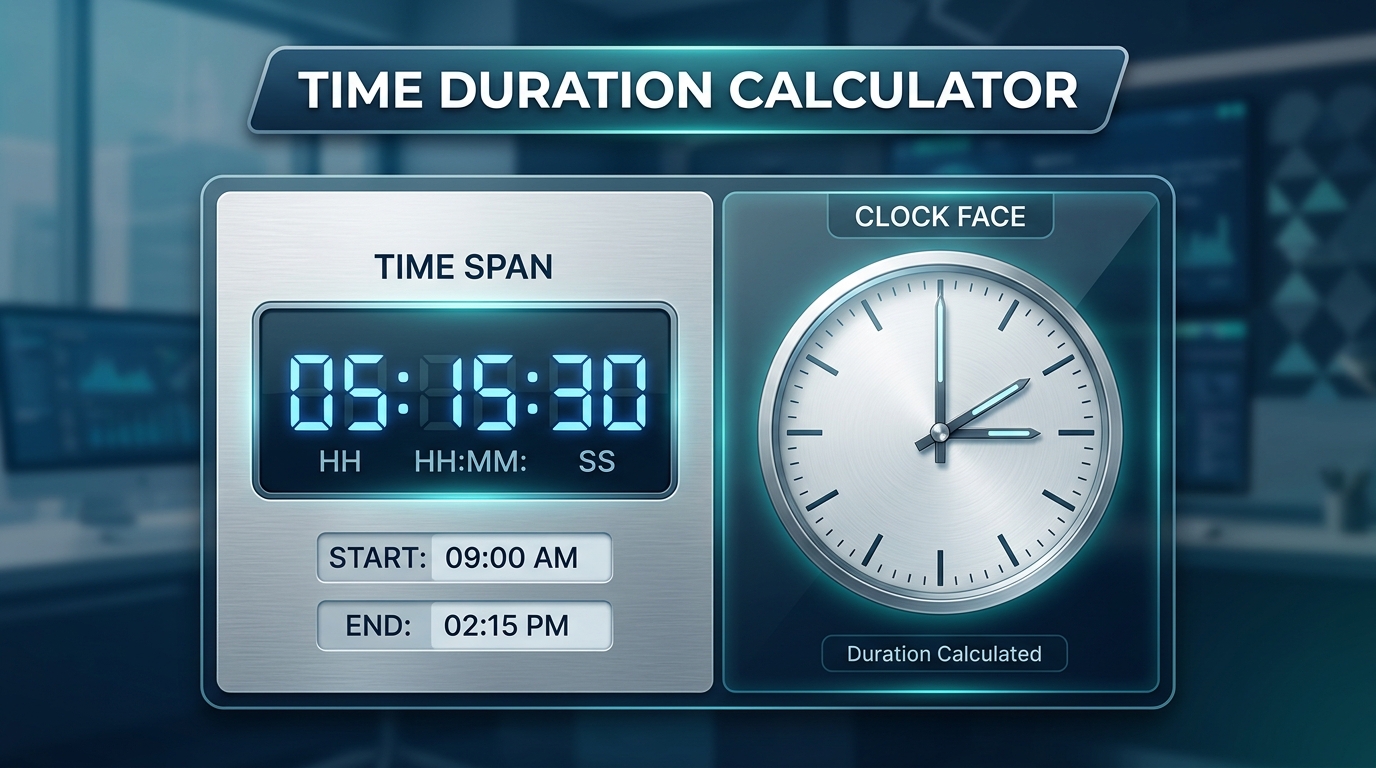
Sometimes you need the total number of hours or minutes rather than a result expressed in days and hours. This is particularly useful for timesheets, invoices, shift records, and project tracking.
Use these conversions:
| Time Duration | Total Hours | Total Minutes |
|---|---|---|
| 30 minutes | 0.5 hours | 30 |
| 1 hour 15 minutes | 1.25 hours | 75 |
| 2 hours 30 minutes | 2.5 hours | 150 |
| 7 hours 45 minutes | 7.75 hours | 465 |
| 8 hours 30 minutes | 8.5 hours | 510 |
| 24 hours | 24 hours | 1,440 |
To convert minutes into decimal hours, divide the number of minutes by 60.
For example, 45 minutes equals 0.75 hours. If a task takes 3 hours and 45 minutes, the total is 3.75 hours.
Time Duration Calculator
Find the difference between two times or calculate elapsed duration.
How to Calculate an Overnight Time Duration
An overnight time duration begins on one calendar day and ends on the next. This commonly occurs with night shifts, hospital schedules, travel, security work, and late-night events.
Example: 10:00 PM to 6:00 AM
Calculate the time from 10:00 PM to 6:00 AM.
Example: 11:30 PM to 7:15 AM
Another example is a shift from 11:30 PM to 7:15 AM the following day. The first part lasts 30 minutes, and the second part lasts 7 hours and 15 minutes.
If you enter only clock times without dates, make sure your calculation method treats the ending time as the following day when appropriate. If you have full start and end dates, enter both dates to avoid ambiguity.
Want a fuller walkthrough of calculating time between two points?
How to Calculate Time Durations Across Months and Years
Longer time duration require calendar-aware calculations because months have different lengths and leap years can add an extra day.
For example, a period from January 15 to March 15 is two calendar months. However, the number of elapsed days depends on the actual dates in the calendar.
When measuring a longer period, distinguish between these results:
These values may differ depending on how you calculate them. For example, counting Monday through Friday inclusively gives five calendar dates, while the elapsed time from Monday at midnight to Friday at midnight is four full days.
For deadlines, subscriptions, project milestones, and booking periods, choose the counting method that matches your actual requirement.
Looking for another time-related calculator?
Time Duration Calculator for Work Hours and Shifts
If you need to calculate working hours, first determine the elapsed time between clock-in and clock-out. Then subtract unpaid breaks if your workplace requires them to be excluded.
For example:
| Work Record | Duration |
|---|---|
| Clock-in | 9:00 AM |
| Clock-out | 5:30 PM |
| Total elapsed time | 8 hours 30 minutes |
| Unpaid lunch break | 30 minutes |
| Net working time | 8 hours |
The same approach works for overnight shifts, provided the correct end date is used.
For payroll or billing, you may also need decimal hours. Eight hours and 30 minutes equals 8.5 hours, not 8.30 hours. This distinction matters when multiplying hours by an hourly rate.
If you are calculating paid time, overtime, or billable work, follow the relevant workplace rules for breaks, rounding, and overtime rather than assuming every elapsed hour is payable.
Need clock-in and clock-out calculations?
Need to subtract a lunch break from your hours?
Looking for a quick way to total your hours?
Common Time Duration Calculation Mistakes
Avoid these errors to get a more useful result:
1. Forgetting That the End Time Is on the Next Day
A shift from 10:00 PM to 6:00 AM lasts eight hours, not a negative duration.
2. Mixing Decimal Hours With Hours and Minutes
A duration of 7 hours and 30 minutes is 7.5 decimal hours, not 7.30 hours.
3. Counting Both Dates When You Only Need Elapsed Time
An inclusive date count can be one day greater than the elapsed calendar-day difference.
4. Ignoring Breaks
The time between clock-in and clock-out is not necessarily the same as paid working time.
5. Treating Every Month as 30 Days
Calendar months vary in length. Use the actual dates for accurate month and year calculations.
6. Ignoring Time-Zone Changes
When a period crosses a daylight-saving transition, elapsed hours can differ from simple clock-time subtraction. For precise real-world elapsed time, use the appropriate time zone and dates.
Want a fuller walkthrough of time calculations?
Frequently Asked Questions About Time Duration
What is a time duration between two times?
A time duration is the elapsed duration from a starting point to an ending point. It can be expressed in hours, minutes, seconds, days, or a combination of these units.
How do I calculate the time between 9 AM and 5 PM?
The elapsed time from 9:00 AM to 5:00 PM on the same day is eight hours. If you take an unpaid break, subtract that break to calculate net working time.
How do I calculate the time between two dates?
Subtract the starting date and time from the ending date and time. For a precise result, include both clock times. If you only need a date difference, calculate the elapsed calendar days and decide whether the end date should also be counted inclusively.
How many hours are in a time duration of three days?
Three complete 24-hour days equal 72 hours. If the period begins and ends at different clock times, calculate the actual elapsed duration rather than simply multiplying the calendar-day count by 24.
Can I calculate a time duration that crosses midnight?
Yes. Enter the appropriate start and end dates, or use a calculation method that supports overnight periods. For example, 11:00 PM to 7:00 AM the following day equals eight hours.
How do I convert a time durations into decimal hours?
Multiply the whole hours by 1 and divide the remaining minutes by 60. For example, 4 hours and 15 minutes equals 4.25 decimal hours.
Does a time duration calculator include breaks?
That depends on the calculator. A basic elapsed-time calculation measures the duration between two endpoints. Breaks must be subtracted separately unless the tool includes a break-deduction feature.
What is the difference between a time duration and a time duration?
The terms are often used interchangeably to describe how long something lasts. Depending on the tool, a time duration may refer to the interval between two dates or clock times, while duration commonly describes the resulting elapsed time.
Calculate Your Next Time Duration More Easily
Whether you are checking a work shift, measuring the time between two events, calculating project hours, or planning a deadline, accurate start and end values make the calculation easier.
Use the relevant tool on Calculator Online Pro to work through your time calculations.
Need to find a future time after adding a duration?
Planning a journey and need to estimate driving time?
Choose the calculation that matches your task, check whether you need elapsed or inclusive time, and use the result to plan your schedule, track hours, or manage deadlines more confidently.